
Where, how, and with what one interacts define one’s identity and scaffolds one’s perception of the world. Hence in a very turbulent market environment, it has become a crucial move for a contemporary enterprise to integrate brand building with interior design so as to provide their customers a unique and unforgettable experience. A brand is now perceived as a network of interrelated points of contact that a consumer has with a company, and the physical world is becoming the most influential space for perception and emotional bonding.
Interior design has evolved to become a platform for brand storytelling, communication, and meeting customer demands. A well-branded interior employs the logos, personality, and codes of a brand through the use of colors, spatial planning, surfaces, and lighting thereby creating a deeper company-client emotional bond and a more holistic brand experience.
The Foundations and Importance of Integrating Brand Building
Integrating brand building into interior design means grasping the idea that a room has a strong influence on the way people see things, behave, and feel emotionally. A brand is not just a logo and a color. It is a representation of the personality, the vision, and the values of the company. Interior design is the vehicle that takes these intangible elements and makes them tangible, thus giving people a brand experience which is real instead of being simply conceptual.
Brand Identity Elements and Their Interior Design Expressions
| Brand Element | Purpose | Interior Design Expression |
| Color Palette | Sets emotional tone | Wall finishes and décor accents |
| Brand Values | Defines personality | Material choices and layout style |
| Typography | Supports consistency | Signage and visual communication |
| Brand Story | Enhances connection | Thematic displays and spatial cues |
One of the ways that brand building integration can be customer trust is through the enhancement of customer trust. Customers who get fully involved in a unified environment are very likely to see the company as a kind one that is well thought out, structured, and dependable. In this way, the company can use interior designs as an indispensable instrument for brand strategy instead of a different field.
Key Aspects of Integrating Brand Building in Interior Design
Integrating brand building needs the focus on various components that, among other things, determine the way surroundings mirror the identity of a brand. These components are the main features that the brand designers use when they are implementing brand principles in the local experience.
Visual Identity and Spatial Alignment
Visual identity is the main tool for recognition. The different colors, patterns, or typography being used are the main working units that co-function to develop the particular style. The interior design is merging these factors into the real world through the choice of the furniture, finishing, lighting, and the direction of the layout. Every one of the decisions is a kind of guarantee that the space is taking the correct message out.
Sensory Elements and Emotional Impact
Brand experiences are not limited to only visual aspects. Sensory design, for example, has a large part in forming memory and emotional response. Involving brand building means also the handling of sound, scent, texture, and temperature. These elements work to the visitors’ emotions. For example, soft surfaces can communicate a sense of comfort. A nice scent can be the symbol of freshness. Quiet sounds can be the reason for calmness in a space.
Comparing Traditional Design and Brand-Centric Design Approaches
The practice of interior design has changed a lot over time. Traditional design mainly concentrates on beauty and utility of the space without giving much consideration to the concept of a singular, cohesive identity. A brand-centric design, on the other hand, literally positions the brand as the ‘identity’ around which every decision revolves. Knowing their differences is advantageous for companies as it facilitates the selection of suitable tactics.
Impact Comparison of Traditional vs. Brand-Integrated Interiors
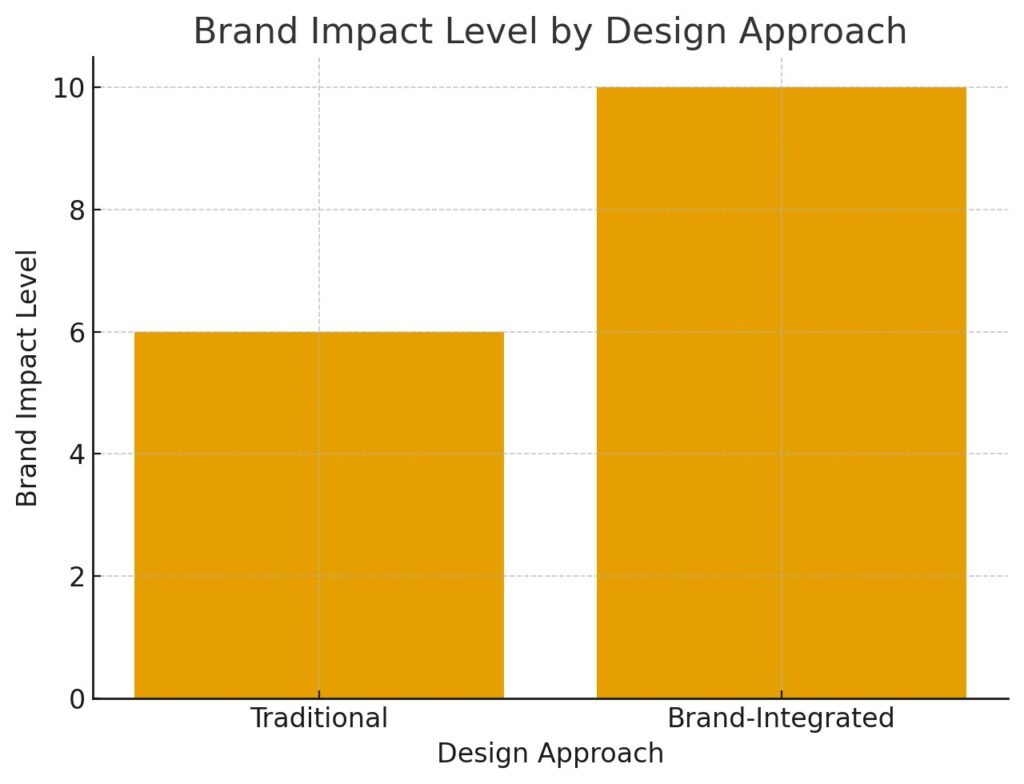
- Brand-Integrated design scores the highest (10), meaning it creates a much stronger brand presence in a space.
- Traditional design sits at a moderate level (6), showing it supports function but delivers weaker brand identity.
- The 4-point gap is significant, indicating that adding brand elements greatly increases perceived impact.
- Brand-Integrated spaces feel more intentional, because colors, materials, signage, and layout all reflect the brand story.
Brand-integrated interiors evoke more powerful emotional ties and higher recall. For instance, a wellness brand could bring in natural materials, gentle lighting, and plants to convey calm and balance. A technology company might employ sleek surfaces and geometric figures to suggest cutting-edge.
Practical Steps for Integrating Brand Building Into Interior Design
By sticking to clear strategies that uphold the company’s identity and functionality, firms may incorporate brand building in the interior design of their spaces. The whole process from branding to the atmospheric environment is converted one step at the time.
- Define brand message and personality
- Align colors, materials, and forms with identity
- Integrate sensory and functional elements
- Ensure consistency across all physical touchpoints
Moreover, design experts ought to think about the users’ conduct as well. Knowing how individuals navigate a room, one can rightly locate the very most important things like exhibits, seats, or work areas. Through brand building integration these locations regain their natural and significant way of existence. The setting, hence, is not just a background anymore. It is a communicator.
The Lasting Value of Integrating Brand Building
Businesses that aim to Absolute Creative develop memorable experiences can benefit greatly from integrating brand building into the interior design as it, basically, adds more value. Because among other things, it solidifies the identity, makes customer trust deepen and ensures that the brand voice remains consistent at every touchpoint.
Thereby when a look is genuinely in harmony with a brand, the place becomes very much purposeful and communicative, and visitors, as a matter of fact, spot the genuineness which, in turn, makes it convenient for them to relate to the setting.