
In the modern business environment, Digital Marketing acts as a fundamental tool for brands to make themselves known, engage customers, and create long-term business sustainability in the digital landscape where consumers increasingly find information and make purchasing decisions online. Digital platforms ease direct communication, measurement of results, experimentation, and fast iteration for businesses.
Unlike customary advertising, the performance of digital marketing campaigns can be monitored in real-time, enabling businesses to refine campaigns and eliminate wastage of spend and resources on ineffective tactics. Digital channels such as search engines and social media support each stage of the customer journey.
Businesses that don’t invest in digital marketing risk becoming irrelevant, as competitors implementing good digital marketing practices are able to build brand credibility. This guide to digital marketing covers digital marketing fundamentals, key digital marketing components, comparisons to customary marketing practices.
Understanding Digital Marketing and Its Importance
Digital marketing is the application of technology, creativity and data to promote products, services and brands through electronic channels. We create traffic to a website, and not only that, but relevant traffic that drives engagement and conversion.
Since consumers prioritize personalization so much, brands can use demographics, interests and behaviors for digital marketing as they segment audiences and send messages that perform better and are more relevant. Then businesses track every click. Then businesses track every visit. Then businesses track every conversion.
Growth, Better Budget Control, and Stronger Brand Trust
The main advantage of digital marketing is scaling: campaigns can be launched on a small-scale and increased based on results. Budgets can be managed better than with customary media, and performance data can be used.
Brand consistency further benefits the company when the same message delivers across multiple touchpoints, leading to recognition and trust. When done correctly, digital marketing builds long-term relationships over one-time sales.
Traditional Marketing vs Digital Marketing
| Feature | Digital Marketing | Traditional Marketing |
| Targeting | Precise audience targeting | Broad audience reach |
| Measurement | Real-time performance data | Limited tracking |
| Cost Control | Flexible and scalable | Fixed and often high |
| Engagement | Two-way interaction | One-way communication |
Search, Content, and Visibility
Search visibility is often the first touchpoint, since companies need to be found when people need answers. Content is key to this because it answers questions, establishes authority, and enables discovery.
Content marketing aids movement through the sales funnel for prospects and customers using blogs, guides, and resources created with quality and frequency.
Data, Channels, and Optimization
Data analytics in digital marketing finds what drives customers to interact and convert, enabling continual improvements.
There are different channels in service for different objectives: building awareness, inducing action, and optimizing to get the most out of resources.
Key components of digital marketing include:
- Search visibility and content development
- Audience targeting and personalization
- Performance tracking and analytics
- Continuous testing and optimization
Digital Marketing vs Limited Online Presence
Companies that have a more well-developed digital strategy will outperform those companies that have very little to no digital strategy outside of a basic website. Digital marketing is about engaging users, not passive presence.
Without digital marketing, brands depend on the serendipity of someone searching. With digital marketing, there is tracking and a pre-planned path. This leads to higher conversion and retention rates.
Performance Comparison Over Time
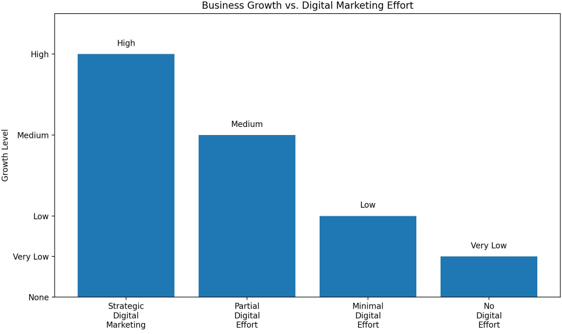
- Businesses with a planned digital marketing plan tend to grow the fastest.
- The growth is fairly medium on average, but the results are very mixed.
- Digital marketing is rarely prioritized, resulting in slower progress and weaker momentum.
- No digital marketing typically limits reach, so it has the least potential for growth.
- Consistent structure within digital campaigns leads to more consistent performance over time.
How to Build a Successful Digital Marketing Approach
Successful digital marketing campaigns often begin through setting goals. This means knowing about what success looks like, whether it’s increased brand awareness, leads, or sales. The correct channel and approach are options based on objectives and a good understanding of the audience. Define who your customer is. Be specific about their needs, issues, and pain points.
Converging platforms, including visual identity, tone, and values, can positively influence brand perception. This builds trust over time. Measurement ensures accountability. Track how you perform to identify what you are good at and where you are weak, and anticipate your next step based on the data.
Steps to strengthen digital marketing efforts:
- Define clear and measurable goals
- Understand and segment the audience
- Align messaging across channels
- Monitor performance and refine regularly
Why Digital Marketing Matters for Long-Term Success
Digital marketing by Absolute Creative is a necessity in business. You can find a digital way to reach your audience wherever they are, and whatever they need. Brands use strategy, data, and creativity to stand out in a sea of competitors. A digital strategy that is great helps visibility, engagement and conversion. This ability for people to respond as behavior changes not only helps businesses adapt inside fast-paced markets, but also invests within sustainable growth during the long-term.
Digital marketing is a long game, building relationships, trust, and authority throughout time. There are opportunities for long-term growth for a business that employs digital marketing – if it is done right.